How to Reduce Mealtime Battles at Home
May 1, 2026
7 Best Vitamins for Picky Eaters
May 7, 2026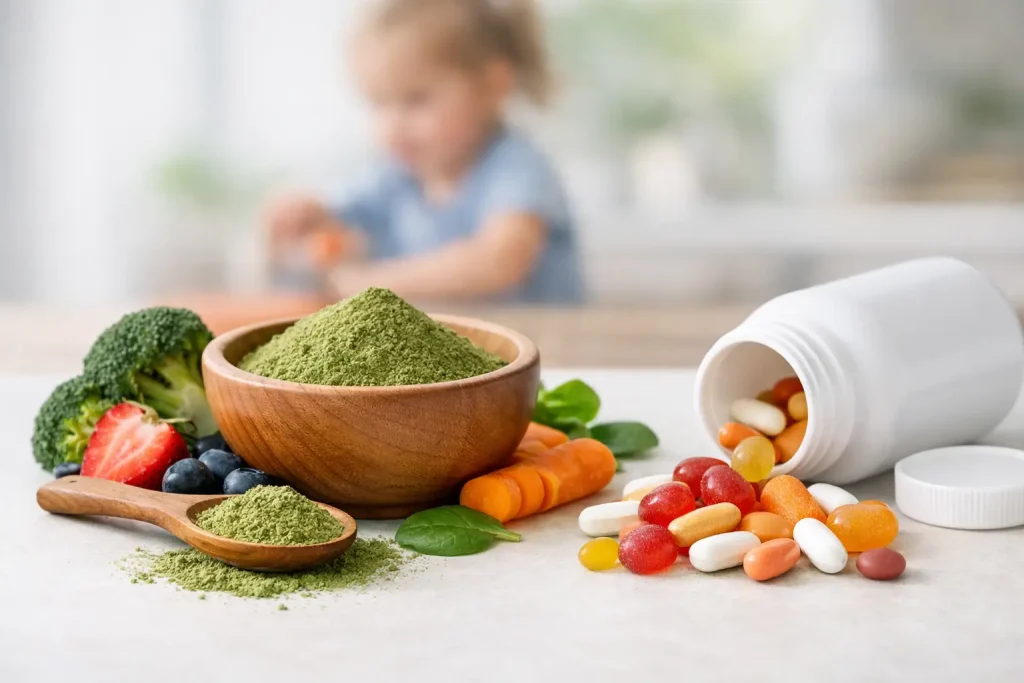
If your child refuses most foods, spits out chewables, or notices the tiniest texture change in a smoothie, the question of whole food powder vs multivitamin is not really about trends. It is about what your child will actually accept, what gives you the most peace of mind, and what can realistically fit into your daily routine without another fight.
For many families, especially those dealing with extreme picky eating, sensory sensitivities, or ARFID-related feeding challenges, the usual supplement advice falls apart fast. A bright gummy vitamin may look easy on paper, but if your child hates the taste, refuses the texture, or melts down at the sight of something new, it is not a solution. At the same time, parents want real coverage, not just a product that feels healthy. That is where this comparison matters.
Whole food powder vs multivitamin: what is the difference?
A multivitamin is usually designed to deliver a list of vitamins and minerals in measured amounts. It often comes as a gummy, chewable, liquid, capsule, or tablet. The main goal is precision. You can look at the label and see specific amounts of vitamin D, iron, zinc, B12, and other nutrients.
A whole food powder is different in both form and philosophy. It is typically made from food-based ingredients like fruits, vegetables, seeds, or other concentrated whole-food sources, then blended into a powder that can be mixed into meals. Depending on the formula, it may also include vitamins and minerals from food-based sources rather than synthetic isolates.
That difference matters because parents are often choosing between two kinds of reassurance. One is the reassurance of exact nutrient numbers. The other is the reassurance of a cleaner, more food-like product that can be added invisibly to something a child already eats.
Neither option is automatically better in every case. The better option is the one that your child will take consistently and that matches what problem you are actually trying to solve.
When a multivitamin makes sense
A traditional multivitamin can be useful when a child needs targeted support and will reliably take it. If your pediatrician has flagged a specific concern, such as low iron, low vitamin D, or limited intake of a nutrient that is difficult to get through food, a multivitamin may offer a straightforward way to fill that gap.
This can work well for kids who tolerate gummies or chewables and do not mind a daily routine around supplements. Some parents also like the simplicity of knowing exactly what is included and in what amount.
But there are trade-offs. Many children’s multivitamins rely on sweeteners, flavor systems, colors, and a candy-like format to make them appealing. For some families, that is a fair compromise. For others, especially parents already trying to reduce sugar, dyes, or highly processed products, it creates a different kind of stress.
There is also the reality of compliance. If your child refuses the vitamin three days out of seven, the label starts to matter less than the behavior. A perfect supplement that your child will not take is not doing much for your actual week.
When a whole food powder makes more sense
A whole food powder often fits better when the biggest challenge is not nutrient theory. It is daily acceptance.
If your child has strong sensory boundaries, limited safe foods, or a history of rejecting supplements because of taste, smell, or texture, a powder that blends into familiar foods can be much easier to use consistently. Instead of asking your child to do one more hard thing, you are working within foods they already trust.
That is a big deal in households where every meal already feels loaded. Parents in this situation are usually not looking for a performance product. They are looking for a nutrition safety net. They want something that lowers risk without raising conflict.
A well-designed whole food powder can also feel more aligned with families who prefer a no-sugar, no-dye, no-synthetic approach. That does not automatically make it superior from a nutrition science standpoint in every context, but it does matter when ingredient quality and formulation style are part of the decision.
The catch is that not all whole food powders are the same. Some are more like greens products made for adults and are far too strong in flavor for a sensitive child. Others may sound healthy but are difficult to mix smoothly or can change the taste of food in ways kids immediately detect. For selective eaters, the formula has to be truly child-compatible, not just technically nutritious.
Whole food powder vs multivitamin for picky eaters
This is where the comparison becomes less abstract and more practical.
For a typically adventurous eater, a multivitamin may be perfectly manageable. For a child with a highly restricted diet, sensory sensitivities, ADHD, ASD, or feeding-related anxiety, the best product is often the one that does not feel like a supplement at all.
Picky eaters do not just reject foods because they are stubborn. Many are responding to real sensory input, predictability needs, and past stress around eating. That means taste, smell, color, texture, and even the expectation of swallowing something unfamiliar can all become barriers.
A gummy vitamin can still fail if it is too sticky, too sweet, too sour, or too obviously different. A liquid can fail because of smell. A chewable can fail because of chalkiness. A whole food powder can fail too if it clumps, changes the texture of yogurt, or makes pasta sauce taste earthy.
So the real question is not only whole food powder vs multivitamin. It is this: which format respects your child’s sensory boundaries enough to be sustainable?
That is why many parents of extreme picky eaters end up favoring an invisible powder that can disappear into foods already in rotation. When it works, it removes the daily negotiation and turns nutrition support into something much calmer.
What to look for beyond the label
It is easy to compare products by the supplement facts panel alone, but parents living this reality know the label is only part of the story.
First, consider acceptance. Can your child take it without a battle? If the answer is no, the rest is secondary.
Second, consider ingredient philosophy. Some families are comfortable with standard synthetic vitamins. Others strongly prefer food-based ingredients and want to avoid dyes, sugar, and artificial flavors. That preference is not trivial. It is part of whether you feel good using the product every day.
Third, think about routine fit. A supplement only helps if it fits the life you actually have. If mornings are rushed, evenings are chaotic, and your child only reliably eats three familiar foods, the product has to work inside that reality.
Fourth, be honest about your goal. Are you trying to correct a known deficiency under medical guidance? Or are you trying to create steadier day-to-day nutrition coverage in a child whose diet is inconsistent? Those are related goals, but not identical ones.
The answer is often more practical than perfect
Parents are often made to feel like there is one correct nutrition choice and everything else is a compromise. Real life with a selective eater is rarely that clean.
Sometimes a multivitamin is the right tool. Sometimes a whole food powder is the better fit. Sometimes a child may need a targeted nutrient recommended by a clinician along with a broader food-based product to support daily coverage. It depends on the child, the feeding challenges, and what is actually sustainable.
If your child eats a wide variety of foods and happily takes a chewable, a multivitamin may be enough. If your child lives on beige foods, notices every change, and rejects anything that feels medicinal, a child-friendly whole food powder may solve a much more immediate problem: getting nutrition support in without escalating stress.
That practical fit is exactly why some families turn to options like InviNutri. For parents who need something invisible, no-sugar, no-dye, and compatible with real sensory limits, the format itself can be the breakthrough.
The best choice is not the one that looks most impressive on a shelf. It is the one that helps your child get more consistent support while making your home feel a little calmer. If a product reduces worry, respects your child’s limits, and works day after day in the foods they already accept, that is not settling. That is smart, sustainable care.