Best No Sugar Multivitamins for Picky Kids
September 14, 2026
Can ADHD Affect Appetite in Kids? What Parents See
September 18, 2026
If your child eats five foods on a good day, the debate around food first nutrition vs supplements can feel painfully out of touch. You already know broccoli is nutritious. You may have offered it 40 different ways. What you need is not another lecture about balanced plates. You need a realistic way to support your child’s nutrition without turning every meal into a negotiation, a standoff, or a source of shame.
For many families, food should absolutely remain the foundation. But when a child has sensory sensitivities, severe picky eating, ARFID-related challenges, or a very limited safe-food list, “food first” cannot mean “food only, no matter what.” A supportive plan has to protect both nutrition and the relationship your child has with eating.
Why food first nutrition matters
Whole foods do more than deliver individual vitamins and minerals. They offer protein, fiber, fats, carbohydrates, and naturally occurring nutrients that work together. They also give children repeated, low-pressure exposure to different tastes, smells, colors, and textures over time.
That is why a food-first approach is a valuable goal. It encourages families to keep offering familiar meals alongside tiny, pressure-free opportunities to see or interact with other foods. It makes room for nourishment that feels like real life: toast at the counter, yogurt after school, pasta on a busy night, and the few dependable foods your child can manage when everything else feels too hard.
But food first should never become a measuring stick for your parenting. A child who cannot tolerate mixed textures, rejects most proteins, or eats only beige foods is not being difficult. Their nervous system, sensory needs, developmental stage, medical history, and past feeding experiences may all be part of the picture.
The goal is not to force a child into eating like someone else’s child. The goal is to reduce nutritional risk while making steady, respectful progress possible.
When food-first advice does not match real life
Traditional advice often assumes a child will eventually eat a varied diet if parents keep serving one. Sometimes that happens. Sometimes it does not happen quickly enough to relieve a parent’s very real concern about what their child is getting day after day.
A limited diet may be temporary, but it can also last months or years. During that time, parents are often caught between two impossible-feeling choices: keep pushing food and risk more distress, or accept the safe foods and worry constantly about gaps.
This is where nutrition support can have a meaningful role. It is not a substitute for meals, nor should it become a reason to stop offering food. It can be a bridge – one that gives parents a little breathing room while their child continues to build trust around eating.
There is also a difference between a child who occasionally refuses vegetables and a child whose food range is genuinely restricted. If your child is losing weight, struggling to grow, coughing or gagging with meals, avoiding entire texture groups, or showing signs of dehydration or nutritional deficiency, bring those concerns to their pediatrician or a qualified feeding professional. Support is not overreacting. It is responsive care.
Food first nutrition vs supplements: it is not either-or
The most helpful answer is usually not “whole foods win” or “supplements fix it.” It is both-and thinking.
Food remains the long-term foundation because children need enough overall energy, protein, fats, fluids, and food experiences – not just a list of isolated nutrients. At the same time, a carefully chosen nutrition product may help fill foundational gaps when a child’s current food intake cannot reliably do that alone.
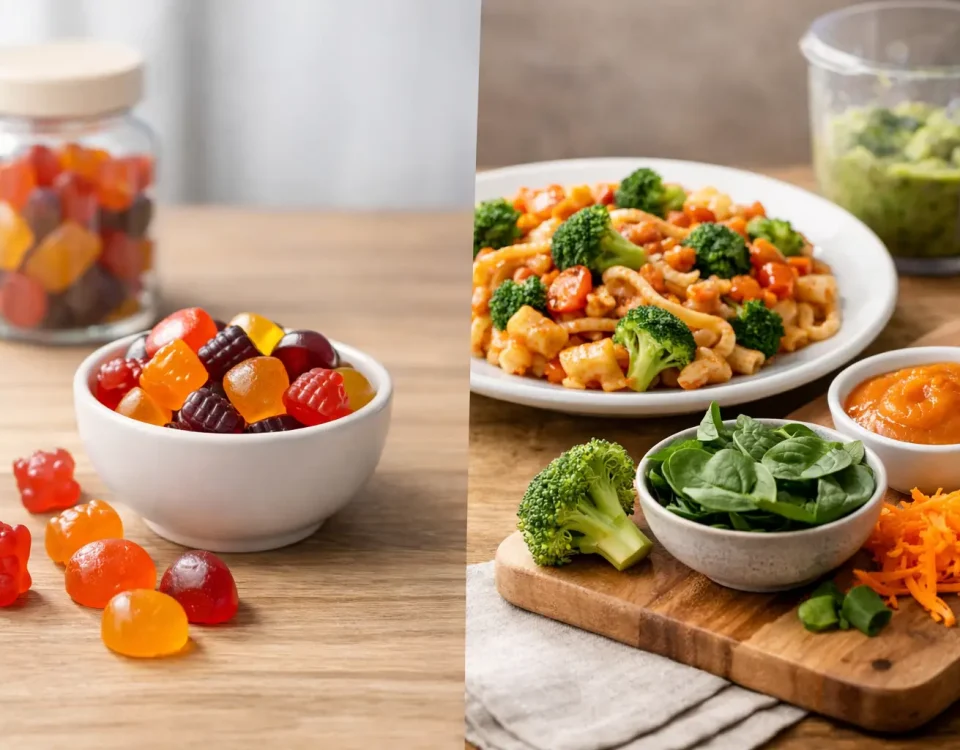
The type of support matters. Some children will happily take a chewable or gummy, but many parents are understandably cautious about supplements with added sugar, artificial colors, strong flavors, or ingredients that feel more like candy than nourishment. Other children cannot tolerate gummies, pills, chalky drinks, or anything that changes the appearance of a familiar food.
For sensory-sensitive children, the delivery method may matter as much as the ingredient list. A product can look excellent on paper and still fail if your child notices a new smell, grainy texture, or slight change in color. That is not stubbornness. It is information about what their body can currently accept.
Whole-food nutrition powders can be a practical middle ground for some families, especially when they are designed to disappear into foods a child already trusts. Rather than asking a child to perform wellness by drinking a new shake or swallowing a supplement, parents may be able to add gentle support to a familiar meal.
What to look for in nutrition support for picky eaters
A good choice starts with your child’s actual routine, not a perfect version of it. Ask yourself where food is most predictable. Is it oatmeal? Applesauce? Yogurt? Mac and cheese? A smoothie only when the same cup is used? The best plan is the one your family can repeat without creating alarm.
Look closely at the label and consider whether the product fits your values and your child’s needs. Many parents prefer options without added sugar, dyes, or unnecessary synthetic ingredients. It also helps to choose support that is straightforward enough to use daily, rather than something that adds another complicated task to an already overloaded morning.
Most importantly, do not frame nutrition support as a consequence for picky eating. Avoid statements such as “You have to take this because you won’t eat vegetables.” Children deserve dignity around food. A calmer approach is to treat the support as a quiet part of the household routine, with no spotlight and no pressure.
That is the thinking behind products such as InviNutri: practical, invisible whole-food support intended to blend into familiar foods without asking a child to tolerate a new taste or texture. For families managing restricted diets, that kind of compatibility can matter more than another aspirational plan that falls apart at the table.
Keep food exposure gentle and separate from nutrition pressure
When you have a safety net, it can become easier to lower the emotional temperature around meals. You can serve a safe food alongside one tiny learning food without needing your child to eat it. A carrot can stay on the plate. A new cracker can be smelled, touched, or moved aside. These are still steps.
Try to keep the jobs clear: your job is to offer food regularly and create a safe eating environment. Your child’s job is to decide whether and how much to eat from what is offered. This does not mean abandoning structure. It means replacing pressure with consistency.
You may also find it helpful to protect at least one reliable food at each meal. That reassurance can reduce panic for a child who has had difficult food experiences, and it can reduce the urge for parents to bargain. Growth often happens more easily when a child does not feel trapped.
Progress may be slow and uneven. A child might lick a new food for three weeks, reject it for two months, then suddenly accept it in a different form. Nutrition support does not make that journey unnecessary. It simply means you do not have to carry every ounce of nutritional worry into every bite.
A calmer standard for feeding your child
You do not have to choose between caring about nutrition and respecting your child’s boundaries. Food first is a strong guiding principle. Supplements or whole-food nutrition support can be a thoughtful tool when food variety is not yet enough.
The right plan is one that helps your child feel safe, helps you feel less alone, and leaves room for tomorrow’s small win – whether that is one more bite, one less battle, or simply a peaceful meal together.