
Mixing Vitamins Into Food Without Mealtime Battles
September 10, 2026
Best No Sugar Multivitamins for Picky Kids
September 14, 2026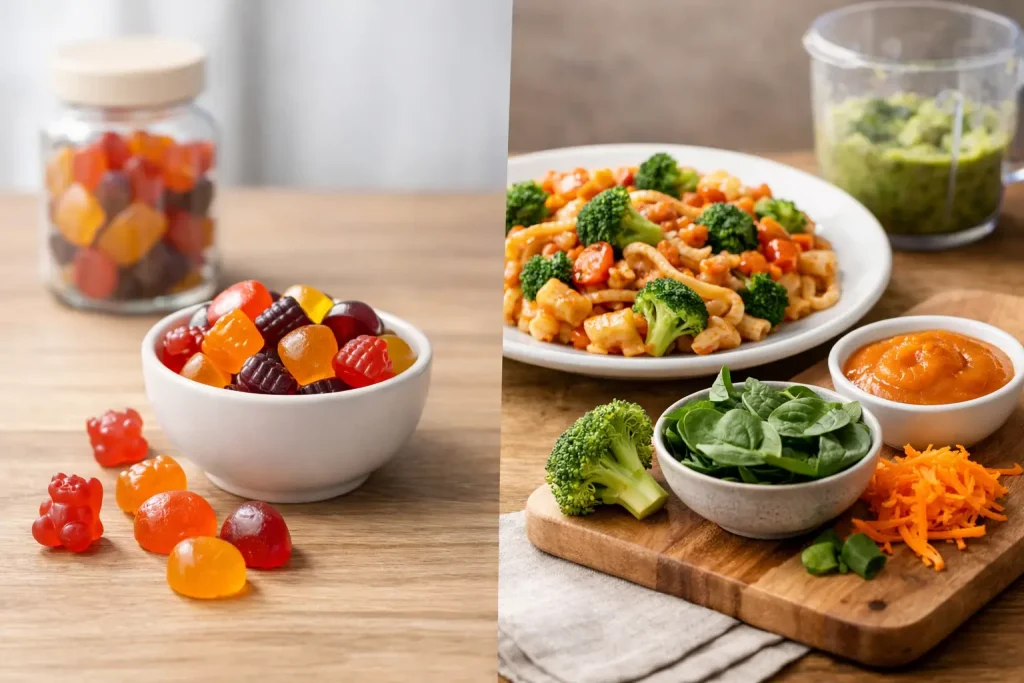
When your child eats only a handful of familiar foods, a gummy vitamin can feel like a small victory. They took it. There was no negotiation. No suspicious look at the plate. But the real question in gummies vs hidden nutrition is not which option looks best in the cabinet. It is which one can support your child consistently without creating another daily point of pressure.
For parents raising selective eaters, children with sensory sensitivities, or kids navigating ARFID-related challenges, nutrition advice often misses the point. “Just keep offering vegetables” may be well-meaning, but it does not help when a new smell, color, or texture can derail an entire meal. A practical nutrition plan has to work with your child’s current capacity, not against it.
Why gummies became the default
Gummies solve a real problem: many children refuse traditional chewable or swallowable vitamins. Their familiar candy-like taste and soft texture can make them more acceptable than a chalky tablet. For a child who will reliably take one, a gummy may be a useful part of a family’s routine.
But acceptance is only one piece of the decision. Many gummy supplements rely on sweeteners, flavors, colors, or a candy-style experience to make them appealing. That does not automatically make every gummy a bad choice. It does mean parents may want to look closely at what is being used to create that acceptance, especially if their child is sensitive to taste, additives, or changes in routine.
There is also the practical question of what a gummy can reasonably provide. Gummies have physical limits. They may be designed around a smaller set of vitamins and minerals, rather than the broader food-based nutrition parents may be hoping to add to a very restricted diet. The label matters, as does the serving size and whether your child will take it every day.
Most of all, gummies can turn nutrition into another “take this” moment. For some children, that is completely manageable. For others, especially those already exhausted by demands around food, medicine, and routines, it can become one more thing to resist.
Gummies vs hidden nutrition: the meaningful difference
Hidden nutrition takes a different approach. Rather than asking a child to accept a new supplement as a separate event, it is blended into a food they already consider safe. The goal is not to trick or pressure a child. It is to reduce the sensory and emotional demands around getting foundational nutrition into their day.
That distinction matters. A child may happily eat a particular yogurt, applesauce, oatmeal, pancake, smoothie, or pasta sauce because it is predictable. If an invisible powder blends into that food without changing the taste, color, or texture, the nutrition can fit inside an established routine rather than competing with it.
For families dealing with severe picky eating, this is often the difference between a plan that sounds good and one that is actually repeatable. The best option is not necessarily the one with the longest ingredient list or the cutest packaging. It is the one your child can tolerate consistently, while helping you feel less worried about the gaps in their diet.
A hidden whole-food nutrition powder may also feel more aligned for parents who prefer to avoid added sugar, artificial dyes, and synthetic-heavy formulas. That does not mean every family needs the same product or the same standard. It means you can choose a route that reflects both your child’s needs and your family’s values.
Sensory safety is part of nutrition
Children do not refuse food to make life difficult. Sensory sensitivity, anxiety, oral-motor differences, limited safe foods, and a need for sameness can all make eating feel genuinely hard. When a child has had difficult experiences around food, even a well-intended supplement can feel like a demand.
This is why taste and texture are not minor details. They are often the deciding factors. A supplement that leaves grit in yogurt, changes the color of a smoothie, or adds a new flavor may be rejected immediately. Worse, it can make a previously safe food feel unsafe.
Hidden nutrition works best when it respects that reality. Start with a food your child accepts reliably, use the smallest reasonable amount at first if the product directions allow, and avoid changing multiple things at once. Keeping the food, bowl, utensil, and routine familiar can protect the predictability your child relies on.
If your child notices even tiny differences, that is not a failure on their part or yours. It is useful information. Try another safe food or another preparation instead of pushing through resistance. Protecting trust around meals matters more than winning one serving.
When gummies may still make sense
There are situations where gummies are a sensible choice. If your child enjoys them, takes them consistently, and the ingredients fit your preferences, a gummy can be a simple way to support specific nutritional needs. Some families also use them when their child is away from home, at school, or spending time with another caregiver.
A gummy may be especially practical when a pediatrician has recommended a particular nutrient and your child accepts that format without stress. The right choice can depend on your child’s diet, age, health history, medications, and any known deficiencies. For individual medical guidance, a pediatrician or registered dietitian is the right partner.
The problem is not gummies themselves. The problem is assuming that a candy-style supplement is the only workable answer for every selective eater. It is not. And if your child refuses gummies, you do not need to keep cycling through flavors, brands, and increasingly tense negotiations.
What to look for in a hidden nutrition option
Not every powder is truly invisible in real family life. Before adding one to your routine, consider how it behaves in the foods your child actually eats. A product may blend beautifully into a thick smoothie but be noticeable in plain water or thin yogurt. Your child’s safe foods should lead the decision.
Look beyond the front label. Consider whether the formula is made from ingredients you feel good about, whether it avoids unnecessary sugar and dyes, and whether it is designed for daily use rather than occasional supplementation. If your child has allergies or medical needs, review the ingredient list carefully and ask their care team when needed.
It also helps to think about the emotional cost. Does this option require reminders, bargaining, or praise that makes your child feel watched? Or can it quietly become part of breakfast, a snack, or dinner they already enjoy? Lowering conflict is not a bonus feature. For many families, it is the reason a nutrition routine can last.
InviNutri was created around this idea of Child Nutrition Safety™: supporting foundational nutrition in a way that honors a child’s sensory boundaries and reduces the pressure parents carry at every meal.
A calmer way to make the choice
You do not have to choose between perfection and giving up. Your child does not need to eat a picture-perfect plate for you to care deeply about their health. A realistic plan can include continued low-pressure food exposure, professional feeding support when appropriate, and a dependable nutrition safety net that fits the foods your child can manage now.
If gummies are working without stress and meet your family’s needs, there is no reason to create a problem where one does not exist. If they are loaded with ingredients you would rather avoid, cover only part of your concern, or have become another daily battle, hidden nutrition may offer a gentler path.
The goal is not to make your child perform “healthy eating.” It is to make sure nourishment has a place in your home without asking your child to sacrifice safety, trust, or calm to get there.